Light Made Permanent: The Luminous Western Watercolors of Marlin Rotach

A Kansas Upbringing, a Lifelong Study of Light
Rotach came to the American West honestly. He was born the son of a commercial artist who also trained stock horses in Kansas, and he grew up among cowboys, horses, billboard layouts, type books, paint, and brushes all at once. That childhood gave him two inheritances at once: a working knowledge of Western life and an early fluency in how images are made. He went on to earn both a BFA and an MFA in painting, then settled in Kansas City, where he keeps his studio.
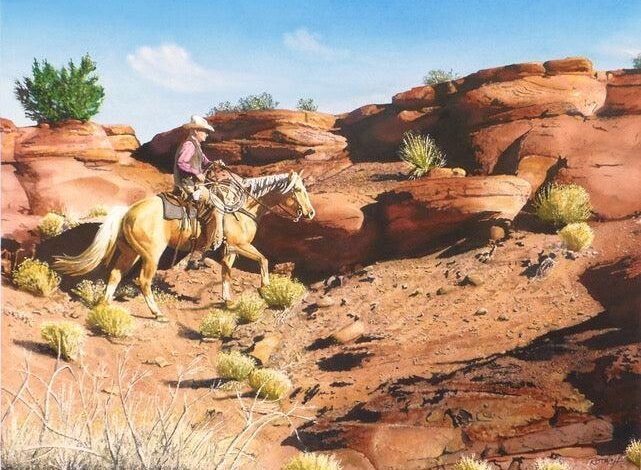
His influences reach far beyond the ranch. Rotach traces his artistic lineage from Caravaggio to Frank Tenney Johnson to Charley Russell, a line of painters bound by one shared obsession: the power of dramatic light and shadow. He carried that obsession into watercolor, where the transparent medium suited his aim exactly. Where other painters build light by adding paint, Rotach builds it by holding paint back, letting the white of the paper itself become the brightest light in the picture.
The Discipline of Transparent Watercolor
Transparent watercolor allows no second chances. Every stroke is permanent, and a lost highlight cannot be repainted. That unforgiving quality is precisely what draws Rotach to it. He plans his highlights before the first wash touches the sheet, thinking in reverse the way a printmaker must, reserving the paper’s brightness from the very beginning.
The results reward close looking. In For Spacious Skies, one of his most ambitious recent paintings, the drama lives in what he withholds. Riders of the Red Cliffs turns the same discipline on stone and rider, the pale sandstone glowing precisely because he never painted it at all. In Cow Pony #2, a horse’s sunlit flank carries a charge that oil often struggles to match. And in quieter works such as The Tracker and Moonlit Rendezvous, Rotach lets deep shadow swallow most of the composition so a single shaft of light can carry the entire story.
Rotach’s subjects range widely, from ranch horses and working cowboys to sweeping high country and intimate floral studies, yet light remains his true subject in every one. A blossom in Summer Splendor receives the same rigorous attention to illumination as the open land of For Spacious Skies. For all his technical command, he approaches each painting as a fresh test. “The goal is always to exceed expectations,” he has said. “The work must be ambitious, otherwise what’s the point?” That restlessness keeps a four-decade career from ever settling into formula.
A Résumé Built on Recognition
Rotach’s credentials read like a survey of his field’s highest honors. He holds signature membership in the Transparent Watercolor Society of America, the National Watercolor Society, and the Watercolor U.S.A. Honor Society, with signature standing in nine national watercolor societies in all. His paintings have appeared in more than two hundred exhibitions, and he has taken eleven Best in Show awards among more than twenty honors overall.
The Western establishment has embraced him with warmth. The Cheyenne Frontier Days Rodeo, one of the oldest and largest in the country, chose his painting for its official poster twice, first in 2014 and again for the rodeo’s landmark 125th anniversary, each selection carrying a purchase award and a coveted trophy buckle. The American Royal named him its featured artist. He has been recognized as a Master Painter of the World, and he effectively wrote the book on his subject, authoring a two-hundred-year history of Western watercolor that spans more than forty painters. Southwest Art, Western Art Collector, and International Artist have all carried his work in print. For collectors who read institutional recognition as a market signal, and the serious ones do, Rotach’s file is deep and still growing.
Source link